A Future of Building Cinematic Universes with Viggle AI: Jon Finger’s Long-Term Passion in Cinematic Storytelling
Viggle
A Future of Building Cinematic Universes with Viggle AI: Jon Finger’s Long-Term Passion in Cinematic Storytelling#
Follow Jon Finger on X.
Viggle: Can you share your background and how it led to your interest in AI and filmmaking?
Jon Finger: I grew up in a creative family. My dad was a watercolor painter, and my grandfathers were engineers—one of them was even an inventor. That mix of troubleshooting and creativity shaped my worldview early on. Film felt like the perfect blend of both worlds: solving problems while being deeply creative.
Initially, I pursued computer science because, as people often say, “No one makes real money in film.” But I didn’t enjoy it—I’m a very visual person, and coding didn’t fulfill that side of me. After making a few short films for festivals and winning awards, I transferred to the film department. That eventually led me to Hollywood to chase the dream.
Once I got there, though, it felt like layer upon layer of corporate risk management and ego-stroking. While I was learning Cinema 4D, exploring tech like 3D printing and drones, I started to feel boxed in by the studio system. I worked on a project for Netflix that took three years of negotiation, only for it to not get greenlit. It was a frustrating system for someone who wanted to create.
One of the early AI companies reached out to me to try their tool. It was my introduction to generative AI—prompting algorithms to interpret text and create visuals. I realized then that if AI could interpret text, it could also interpret gestures and facial expressions. And hopefully 3D worlds.
Viggle: How did you first discover Viggle, and how does it fit into your creative process?
Jon: I saw Viggle early on, and it was exactly the direction I hoped creative AI technology would go. The challenge is that traditional tools are so mature and give you a lot of control, whereas Viggle initially felt like a lesser version of motion capture. But with the V3 model, Viggle has become incredibly compelling—it’s now comparable to certain mocap tools.
Even though I have to handle relighting myself, that’s fine for now. Viggle gives me the foundation to act out ideas and bring characters to life, which aligns perfectly with the kind of storytelling I want to pursue.
Viggle: Can you walk us through your workflow using Viggle and other tools?
Jon: Sure! My workflow is super simple because Viggle is really that easy and quick. Here’s how I approach my projects:
- Acting: I act out the scenes myself to capture the movement and expression I want.
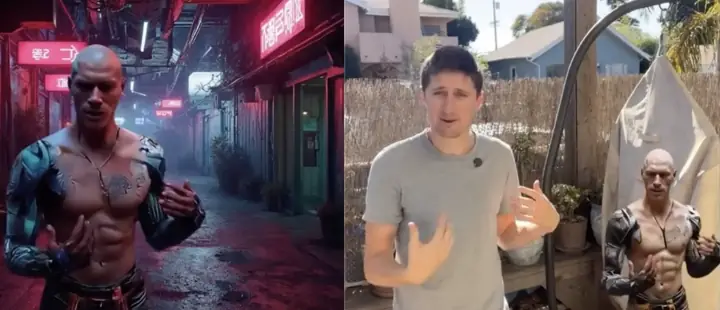
- Viggle: I use Viggle to bring those performances to life through motion capture.
- Relighting: I use Magnific to relight the scenes and add depth and realism to the visuals.
Viggle: What’s your perspective on AI’s role in filmmaking?
Jon: My dream is to build and explore worlds—like the Marvel Cinematic Universe— without needing anyone’s permission. In the short term, I’m focused on building a pipeline where I can create and store assets to tell a 20-minute story. Once I have that, I want to expand into a series of interconnected stories.
Right now, the AI technical stack isn’t fun yet—it’s clunky and requires a lot of workarounds. But Viggle V3 has been a game-changer. It’s the only AI tool I’m thinking about regularly because it gets me closer to the kind of storytelling I want to do. It just needs the ability to hold and interact with items to push things even further.
Join our creator program to enjoy Pro features and the latest product updates!
Reach out to us at [email protected].