Viggle Interviews Ryan: From Film to Generative AI Content Creation
Viggle
Viggle Interviews Ryan: From Film to Generative AI Content Creation#
Source: Ryan Phillips's X
Follow Ryan Phillips/Uncanny Harry AI on X.
Viggle: Ryan, it's a pleasure to have you with us! You've had such an interesting career. Could you tell us a bit about your background and how you ended up working with AI tools like Viggle?
Ryan: Absolutely! I've spent over 20 years in TV, most recently as a lead director for the BBC. I've also always been a short filmmaker at heart, and I studied film at Southampton. Early in my career, I even had a few projects funded by the British Film Institute (BFI) as part of the UK's public funding for filmmakers. Unfortunately, none of those early ideas fully took off.
Post-pandemic, I noticed that the tech was really advancing, and platforms like Midjourney and Runway Gen1 were starting to change what was possible. I jumped into the world of generative AI as "Uncanny Harry" on Twitter and was immediately captivated by the pace of change. The opportunity to create AI-powered content, like interactive content for Dreamflare, and experiment with tools like Viggle was too exciting to pass up.
Viggle: Your experience really highlights the potential for AI in film and advertising. Can you tell us how you got started with Viggle?
Source: Ryan's early test on Viggle
Ryan: I was actually one of Viggle's earliest users back in March this year, before AI Warper's work even went viral. Viggle opened up a whole new set of creative possibilities for me. At first, I was experimenting by filming myself, then layering Viggle animations onto the footage. I remember creating a boxing scene where I added Viggle characters, though I had some challenges with face consistency. But since then, my workflow has evolved—I now use Viggle for the initial animation pass and combine it with Runway Gen3 to add more detail and upscale.
Viggle: It's fantastic to see how you've adapted your workflow to make the most of generative AI. Can you walk us through your current process?
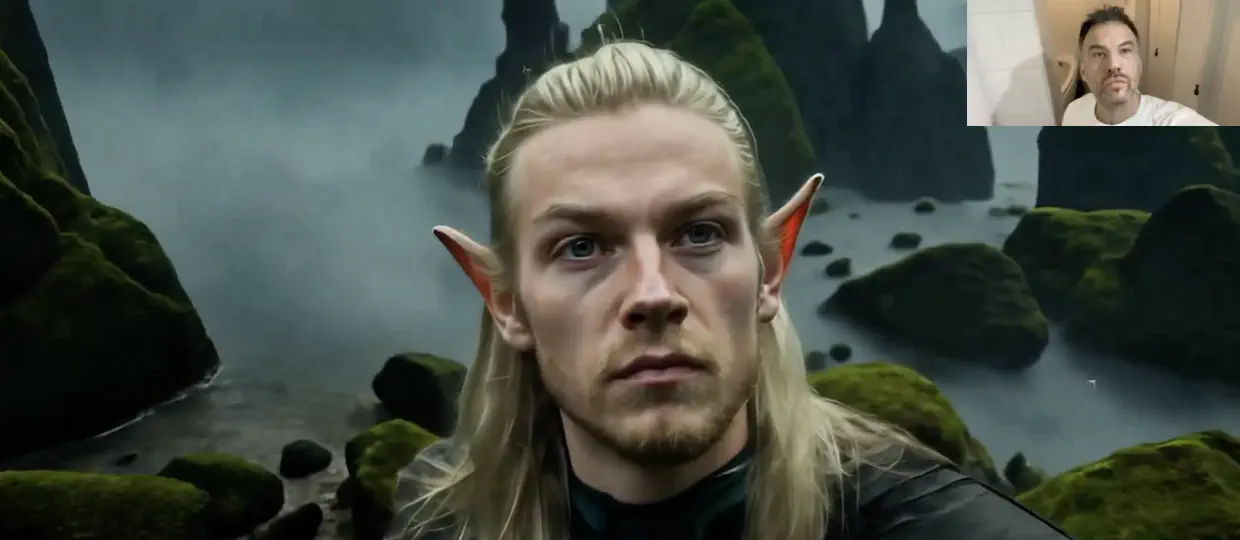
Ryan: Sure! My workflow varies depending on the project, but for a recent project featuring an elf character, here's what I did:
- Concept and Shoot: I shot the footage on my phone with a clear background and uploaded it directly into Viggle for the initial animation. Viggle's character transformation allowed me to give the elf character a lifelike movement.
- Character Generation: I created the elf character using prompts, then uploaded it to Viggle's V2 mode, which has more facial detail. This allowed the character to have an expressive, animated presence.
- Adding Backgrounds with Runway Gen3: I used Runway Gen3's video-to-video feature to prompt the background, and it worked beautifully. It took my elf character as is but gave it a more realistic feel, making it look like part of the scene.
- Upscaling: For the final touches, I upscaled the video to 4K on Topaz using cloud computing. It costs around £50 a month, but it's essential when creating high-quality output. If I'm just sharing fun clips with friends, though, Viggle's mobile output is more than enough.
Source: Ryan's X
Viggle: What excites you most about working with Viggle and generative AI?
Ryan: Viggle has been a game-changer in enabling creators to test ideas quickly and affordably. It's a versatile tool that's great not only for social media content but also has huge potential in larger production environments. I'm especially excited about where 3D generative workflows are headed. Imagine giving filmmakers the power to create entire worlds in a 3D space. Right now, creating consistent environments takes a lot of work—typically, you'd build a 3D model, use it as a reference, and then generate backgrounds using LoRAs. But platforms like Sky Glass and advancements from Runway are pushing us closer to making that process more streamlined. AI in filmmaking is here to stay. We're on the verge of being able to generate immersive 3D worlds from a single image, and even Runway has expressed interest in this direction. It's an incredibly exciting time.
Viggle: What do you see as the future of AI tools in the film industry?
Ryan: There's no doubt that AI is going to permanently alter filmmaking. The VFX process, for instance, will become much faster, enabling things like realistic rain or other natural effects on-demand. The next big leap will be in creating fully interactive, generative 3D worlds. Right now, Midjourney is starting to take a single image and imagine a 3D space from it, with the aim of eventually generating video. The potential here is huge, and it's only a matter of time before these tools are fully integrated into professional film production workflows.
Viggle: Anything else you'd like to share about your experience with Viggle?
Ryan: Viggle is so versatile—it's perfect for quick social content, but I see so much potential for more serious applications in the industry. It's truly the Wild West for AI content creation right now, and there's no pre-existing network for AI creators. Most of us are finding each other on social platforms like Twitter, and Viggle is becoming a key tool that everyone in the space knows about. I'm really excited to see how Viggle continues to evolve and push the boundaries of what's possible.
Viggle: Ryan, thank you so much for sharing your insights with us. It's been inspiring to learn about your journey from traditional film to generative AI and the role Viggle has played in it. We can't wait to see what you create next!
Join our creator program to enjoy Pro features and the latest product updates!
Reach out to us at [email protected].