AI 3D Animation in a Real Production Pipeline
Where AI 3D animation actually fits in a production pipeline, what it hands off, how review changes, and how to trial it on one shot without disruption.
Viggle

Key Takeaways#
- AI 3D animation enters a pipeline at blocking, previs, secondary characters and iteration passes. It does not enter at final, and pretending otherwise is how adoption fails.
- PINOC fits the generation slot and nothing else: motion in about a minute, previewed before export, out as FBX or GLB. Everything downstream stays where it was.
- The hardest problem is not quality, it is review. A team that cannot tell a generated first pass from a finished shot will approve the wrong thing.
- Cheap generation multiplies takes, which turns asset management into a real problem rather than an afterthought.
- Adoption is close to universal while confidence is not. 90% of surveyed developers report using AI in their workflow, and only 29% think it helps small studios compete.
- Trial it on one shot in a sequence nobody is watching, not on a hero shot and not across a whole department.
- Every handoff needs to state what is fixed, what is open and who owns the next change. Without that, generated work gets treated as intent.
- The craft judgment about what a movement means stays with the animator. That is the part no current tool touches.
Most writing about AI 3D animation is either a demo reel or a threat assessment. Neither is much use to someone who has to decide whether this belongs in a working pipeline next quarter.
The practical question is narrower. Where does generated motion actually enter, what does it hand to the next person, what breaks in review, and how do you find out without disrupting a department that is already shipping?
This is an evaluation rather than a pitch. It includes the parts that do not work.
Where Does AI 3D Animation Actually Enter a Pipeline?#
At the stages where volume matters more than specificity. That is blocking, previs, secondary and background characters, and iteration passes. Four places, all of them upstream of polish.
The classic pipeline runs reference, blocking, splining, polish. Generated motion replaces or accelerates the first two and leaves the last two alone. What changes is not the shape of the pipeline but the cost of its early stages, which changes how many ideas get tested before one is chosen.
- Blocking. A generated base layer replaces keying from zero. The animator refines rather than builds, which is a different task with a different skill emphasis.
- Previs. The highest value entry point, because previs is disposable by design and fidelity requirements are low.
- Secondary and background characters. The twenty people in the crowd who need to behave rather than perform.
- Iteration. Testing four versions of a movement feel instead of defending the first one, which is only possible when regenerating is cheap.
Where it does not enter is equally important. Hero shots, anything stylized or exaggerated, signature movement that establishes character, and any contact critical action where a frame of misalignment reads as a miss.
| Pipeline stage | Generated motion role | Who owns the result |
|---|---|---|
| Previs and blocking | Primary. Produces the pass outright | Layout or previs artist |
| Secondary characters | Primary, with light cleanup | Animator, low touch |
| Hero shot animation | Reference layer at most | Animator, fully hand owned |
| Facial and finger work | Not currently viable | Animator or specialist rig |
| Final polish | None | Animator |
What Does a Generated First Pass Actually Hand Over?#
A plausible base layer on a skeleton, with correct gross motion and unreliable detail. Knowing precisely what that means is what makes the handoff work.
The gross motion is usually right. Stride, weight transfer, the overall shape of the action, the timing at a coarse level. The detail is where it degrades. Contact frames land softly, extremities drift, and the specificity that makes a performance belong to a character is largely absent.
That profile is consistent enough to plan around, which is more useful than it sounds. You can staff and schedule against a known failure pattern.
The Handoff Contract#
Every generated pass that changes hands needs four things stated explicitly. Without them, the receiving artist has to guess whether they are looking at a suggestion or a decision, and they will usually guess wrong in the expensive direction.
- State. Is this generated, corrected or approved? Three different words for three different levels of commitment, and the file name should carry one of them.
- Fixed. What must not change? Usually timing, because editorial has cut to it. Sometimes contact points, because the environment is built around them.
- Open. What is explicitly up for grabs? Naming this prevents an animator politely preserving something nobody cared about.
- Ownership. Who makes the next change, and does rejecting this pass mean regenerating or hand keying? Deciding this in advance stops a shot bouncing between two people.
Most failed adoptions in this area are handoff failures rather than quality failures. The motion was fine. Nobody knew what they were allowed to do with it.
How Does Review and Approval Change?#
Review gets harder before it gets easier, because generated work looks more finished than it is. That mismatch is the single biggest operational risk.
A hand blocked pass looks unfinished, so nobody mistakes it for final. A generated pass has smooth interpolation and plausible weight, so it reads as further along than it is. Directors approve it. Editorial cuts to it. Then somebody discovers the contact frames are soft and the shot has to change after decisions were built on top of it.
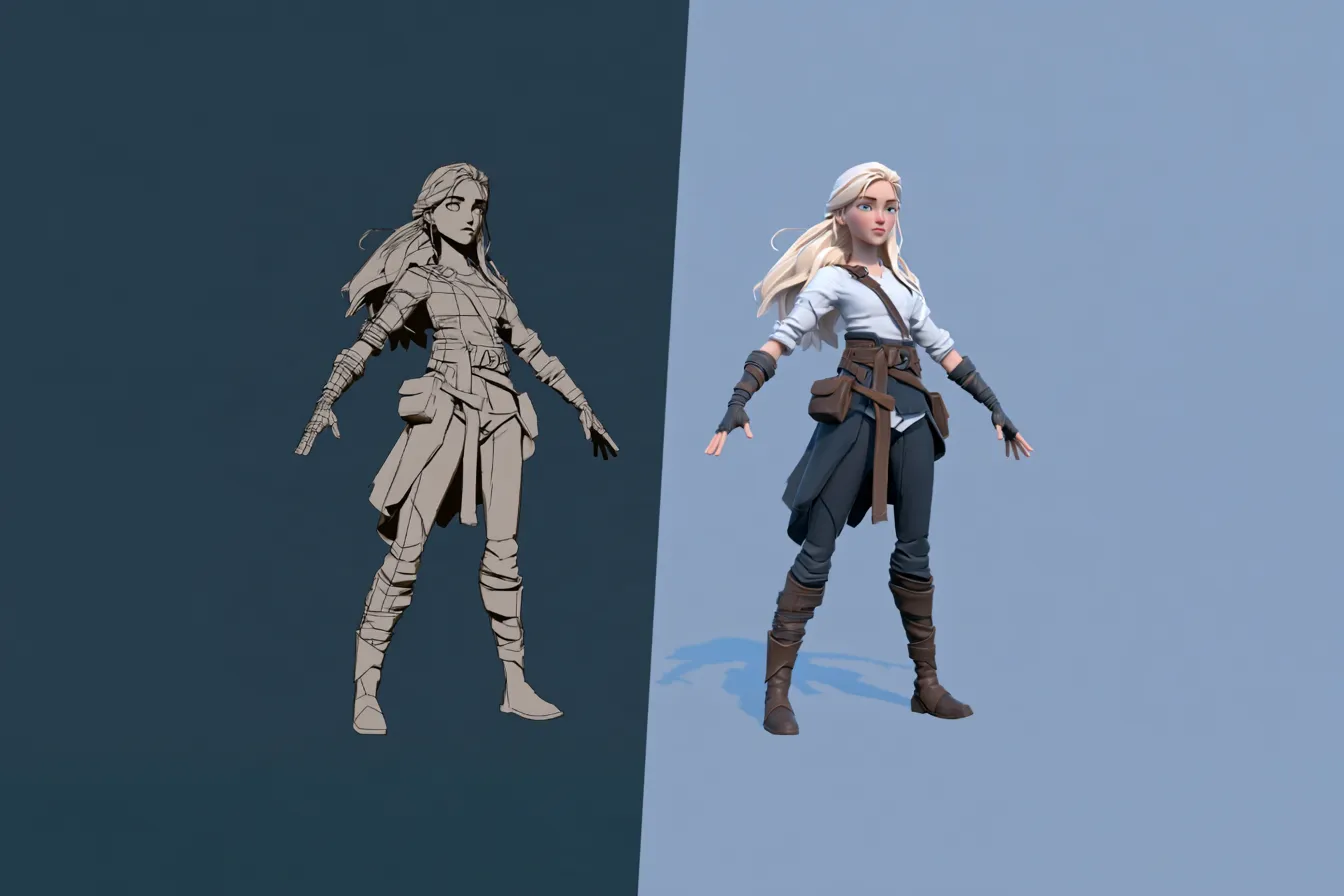
- Present generated passes in a deliberately rough state, grayscale and unlit, so nobody reviews the wrong layer
- Say the word first pass out loud in every review, every time, until it stops needing saying
- Show two variants rather than one. A single option invites approval, two invite a decision
- Separate approval of timing from approval of performance, because the first is usually safe to lock early and the second is not
The evidence supports treating this carefully. The GDC 2026 survey found 64% of visual and technical artists holding unfavorable views of generative AI, which is the room you are presenting into. In August 2025, Google Cloud research conducted by The Harris Poll found 90% of surveyed game developers already integrating AI into their workflows, with 36% using it for level design, animation and dialogue. The same study found only 29% believed AI genuinely helps indie studios compete with larger ones. Near universal adoption, distinctly mixed confidence.
What Happens to Asset Management When Takes Are Cheap?#
You get a versioning problem you did not previously have. When generating four variants costs a minute, people generate four variants, and most teams have no convention for what happens to the three they did not pick.
This is genuinely underrated as an adoption blocker. It does not show up in evaluation, when one person is testing one shot. It shows up in month three, when nobody can find which take editorial approved.
- Name takes at generation time rather than after selection, since you will not remember the difference later
- Keep the prompt or source clip alongside the output. Reproducing a result you cannot describe is impossible
- Decide early whether rejected takes are deleted or archived, and make it a rule rather than a habit
- Flag anything hand touched, because a generated file that has been edited is no longer reproducible
That last point matters more than it appears. The moment an artist adjusts a generated clip, its provenance breaks, and regenerating it will not return what you had.
Where Does This Currently Break?#
Non human motion, extremity detail, and anything requiring interaction between characters. These are consistent limits across the category rather than gaps in any single tool.
- Quadrupeds and creatures. These models are trained overwhelmingly on human capture, so anatomy outside that distribution is poorly handled and no phrasing fixes it.
- Fingers and faces. Last to arrive, first to look wrong, and often absent entirely from a given tool’s output.
- Character interaction. Two people making contact is outside what several tools support at all.
- Exaggeration. Models trained on real capture pull toward realism by construction, so stylized work fights the tool rather than using it.
- Provenance. Licensing and training data questions remain live, and are worth resolving before a shipping project depends on the output.
An honest statement of scale helps here too. McKinsey’s January 2026 analysis of film and television production found leaders reporting productivity gains of five to ten percent in specific use cases. Real, worth having, and nowhere near the transformation the marketing describes.
How Does PINOC Fit an Existing Pipeline?#
PINOC occupies the generation slot and nothing else. It produces motion from a clip or a written description and exports it as FBX or GLB, then gets out of the way.
“A NEW Video 2 Mocap Tool - PINOC!”, a review by CGDive (Blender Rigging Tuts). Watch on YouTube.
For pipeline purposes the important property is portability. Every clip lands on the same 65 bone rig, and its bone names are ones any Mixamo compatible retargeter already knows, so integration is a retarget rather than a bespoke import path. Where a team wants its own character in from the start, uploading the mesh and having it rigged and retargeted inside the tool removes the round trip entirely.
The model underneath is JST, Viggle’s in house foundation model. It was trained with physical priors rather than pure pose data, which is what keeps mass and contact readable in the output and reduces how much correction the first pass needs.
- Roughly a minute per run, with multiple takes so a review can be given options rather than one answer
- Viewport preview on a character before anything is exported, which keeps bad takes out of the pipeline entirely
- Text to motion covers the moves with no reference footage, which is most of what previs needs
- Exports into Blender, Unity, Unreal, Maya, Cinema 4D and Houdini
- The free tier includes credits covering about a minute of motion, which is enough to run a genuine one shot trial
Indie developer William (@DLKFZWilliam2) shares a working rig, mocap and retarget pipeline test. View the original post on X.
How Should a Team Trial This Without Disruption?#
One shot, one artist, one sequence nobody is watching. Department wide rollouts of unproven tooling fail for reasons that have nothing to do with the tooling.
Pick a background character in a mid ground shot. Give it to an animator who is skeptical rather than enthusiastic, because an enthusiast will make it work and tell you nothing. Measure two things only, time to a reviewable pass and time from there to final.
- Week one. One shot, one artist, no pipeline changes. The output is a time measurement, not a shot.
- Week two. The same artist on five shots, to see whether the saving survives repetition or was a novelty effect.
- Week three. A second artist on the same five, to separate the tool from the person.
- Then decide. If the second artist does not see the saving, the tool is not the reason the first one did.
One opinion, stated without hedging. The teams that get value from this are the ones that adopted it for volume work they were already resenting. The teams that fail are the ones that adopted it to reduce headcount and then discovered that the remaining work was the hard part all along. Which of those you are will predict the outcome better than any feature comparison.
Frequently Asked Questions#
Can AI 3D animation replace animators?#
No, and the pipeline evidence is fairly clear on why. Generated motion is reliable on gross movement and unreliable on the detail that carries intent, which is precisely the part animators are employed for. What changes is the entry point, since refining a base layer is different work from keying from zero. Teams that treat it as a replacement rather than a first pass tend to discover the gap late and expensively.
What is the best entry point for AI motion in a pipeline?#
Previs and background characters, because both tolerate imperfection and both consume volume. Previs is disposable by design, so a rough pass is the correct fidelity rather than a compromise. Background characters need to behave rather than perform. Starting at either point lets a team learn the tool without a hero shot depending on the outcome.
How much cleanup does generated animation need?#
Treat it as a blocking pass rather than a finished clip. Typical work covers contact frames, foot sliding after retargeting, timing adjustments to fit your feel, and trimming to the useful beats. Secondary characters often ship with very little. Anything held on screen long enough to study will need real attention, and budgeting for that up front is what keeps schedules honest.
Does generated motion work with an existing rig?#
Yes, through retargeting, and how painful that is depends entirely on skeleton naming. Motion arriving on a widely used convention maps almost automatically in most retargeting tools. Motion on a proprietary skeleton means manual bone mapping for every clip until somebody builds a preset. This is the single largest hidden cost when evaluating tools, so test it before committing.
Who owns the copyright on AI generated animation?#
It depends on the tool’s license and on your jurisdiction, and this varies more than teams expect. Check whether commercial use is permitted on the specific plan you are on, since several products allow it only on paid tiers. Resolve this before a shipping project depends on the output, and keep a record of which clips came from where in case provenance is questioned later.
Is it worth adopting if my team is small?#
Often yes, though the evidence is less one sided than vendors suggest. Only 29% of surveyed developers believed AI genuinely helps small studios compete with larger ones. The gain is most reliable where a small team faces a volume problem it cannot staff around, such as a full animation set for a shipping game. It is least reliable where the work is bespoke and small in quantity.
Conclusion#
The pipeline question is not whether generated motion is good enough. It is whether your team can tell a first pass from a final one, and whether the handoff makes that explicit.
Get that right and the rest is straightforward, because the tooling genuinely does compress the early stages. Get it wrong and you will approve a base layer, cut to it, and pay for the mistake three departments downstream.
Adopt it where you already have too much work of a kind nobody enjoys. Keep it away from the shots you would put on a reel.