The Mixamo Alternative
for motion the library does not have
Custom motion for characters Mixamo will not rig, including where Mixamo still wins.
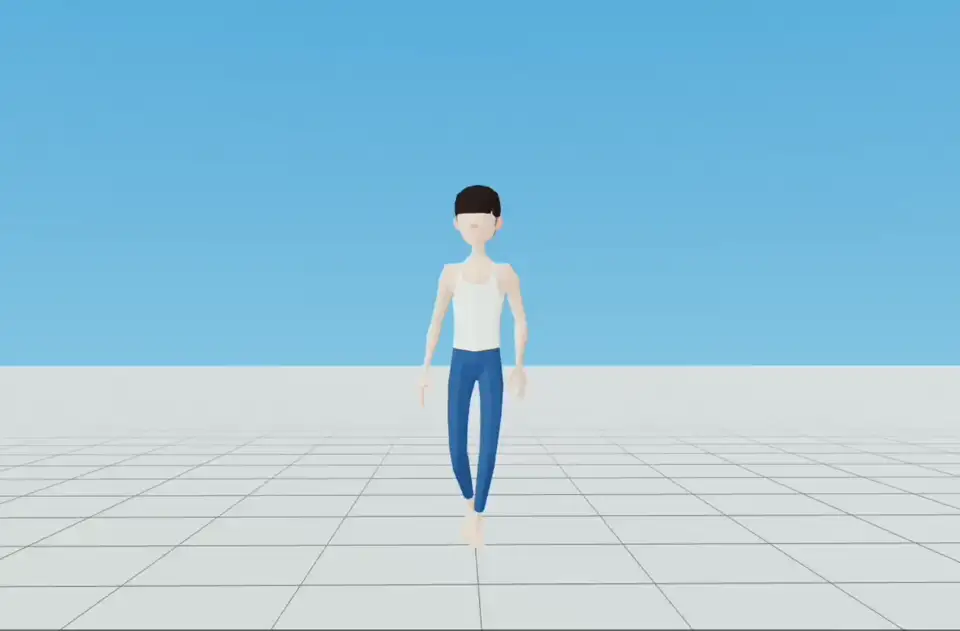

Mixamo vs PINOC, criterion by criterion
| Criterion | Mixamo | PINOC |
|---|---|---|
| Custom motion, a move that exists in no library PINOC advantage | Mixamo cannot create new motion. If a clip is not in its library, it does not exist. | PINOC generates any move on demand, from a reference video or a text prompt. |
| Motion from your own video footage PINOC advantage | Mixamo has no video capture of any kind. | PINOC turns any clip of a person moving, phone, webcam, screen recording or internet footage, into 3D skeletal animation in about 1 minute, with no clip length limit. |
| Motion from a text prompt PINOC advantage | Mixamo does not generate motion from text. | PINOC creates 3D animation from a natural-language description, with multiple takes per run and controls for clip length, variations and a first or last frame pose image. |
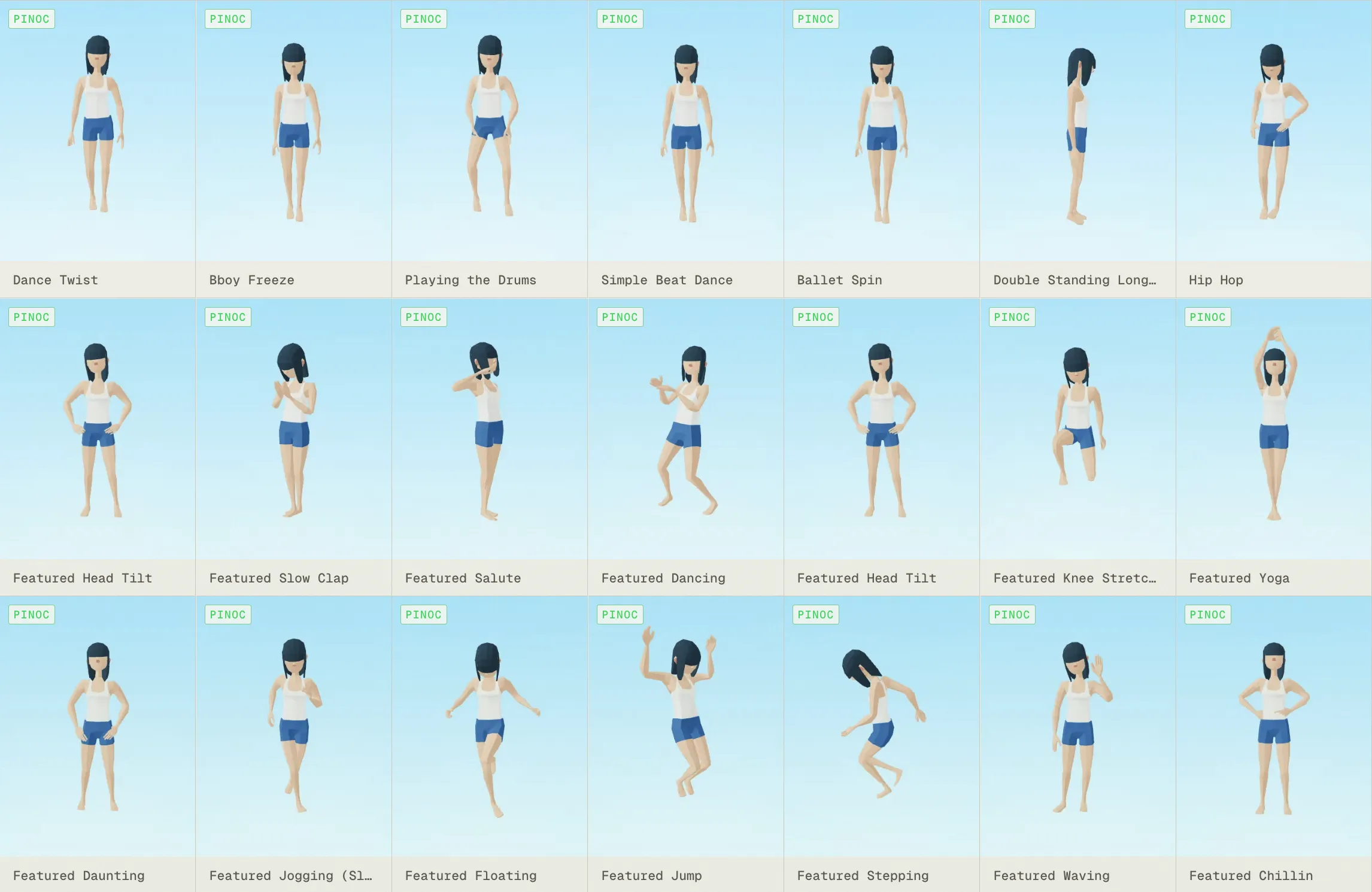
| Ready-made clip library Mixamo advantage | Mixamo ships roughly 2,400 polished, ready-made mocap clips, free to download. | PINOC ships a free built-in library of 50+ production-ready game staples — walk, run, idle, attack — unlimited to use and export, and generates on demand any move the library lacks. |
| Auto-rig your own model Mixamo advantage | Mixamo's one-click auto-rig is the fastest option for a clean standard humanoid. | PINOC auto-rigs from a handful of guide markers, so it also handles models Mixamo rejects. Rigging spends no credits. |
| Retarget onto an existing rig PINOC advantage | Mixamo re-rigs your mesh rather than retargeting onto a rig you already have. | PINOC detects the rig type, maps 7 required bones and up to 45 optional including fingers, and corrects A-pose to T-pose. |
| Non-standard proportions and stylised characters PINOC advantage | Mixamo's auto-rigger frequently fails on stylised or non-standard models, with no manual fallback. | PINOC's marker-based rig handles stylised proportions, and a single character image can become an animatable 3D character. |
| Preview motion on your character before export PINOC advantage | Mixamo previews its library clips on an uploaded character. | PINOC previews captured, generated and retargeted motion on your own model before you commit or spend an export. |
| Export format and skeleton | Mixamo exports FBX and DAE on its own skeleton, the naming convention the industry adopted. | PINOC exports FBX and GLB on a 65-bone Mixamo-named skeleton or a MetaHuman rig, plus USDZ with a preview body, and Rigged GLB or FBX Binary for your own uploaded character. |
| Price to start Mixamo advantage | Mixamo is free with an Adobe ID, with no credit meter at all. | PINOC is free to start with 60 credits, no card required. Paid plans from $12.99/mo. |
Why do people look for a Mixamo alternative?
The move you need is not in the library
Mixamo's library is fixed at roughly 2,400 clips and has not grown in years. PINOC generates the exact move instead, from a reference video or a text prompt, in about 1 minute.
Mixamo's auto-rigger rejects the character
Stylised proportions, extra limbs off the silhouette, or a non-standard pose will fail Mixamo's rigger with no recourse. PINOC's marker-based auto-rig handles those models, and rigging spends no credits.
The tool feels abandoned
Mixamo has been effectively unmaintained for years and has had repeated outages. Teams shipping on a deadline want a tool that is actively developed, which PINOC is.
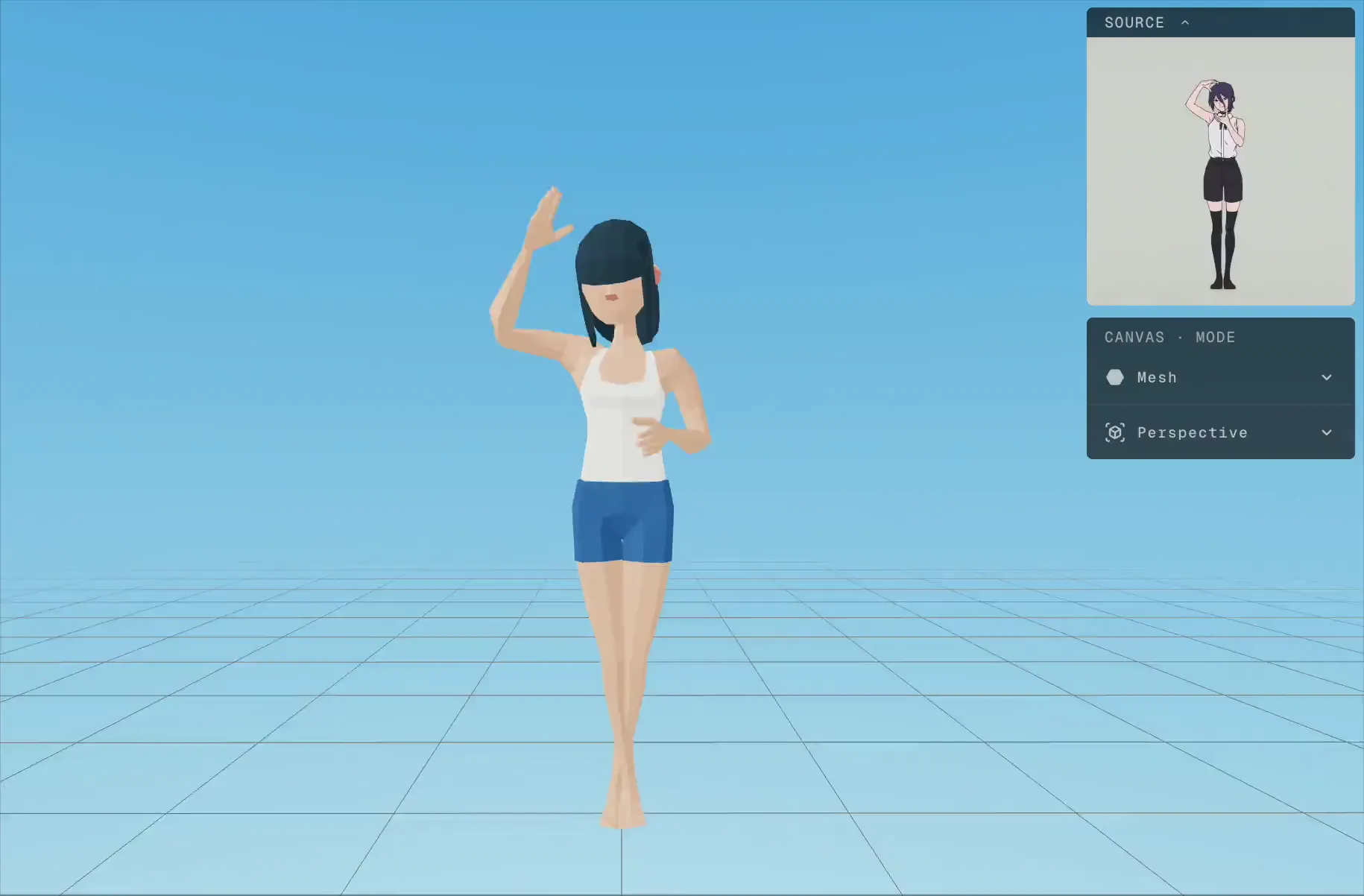
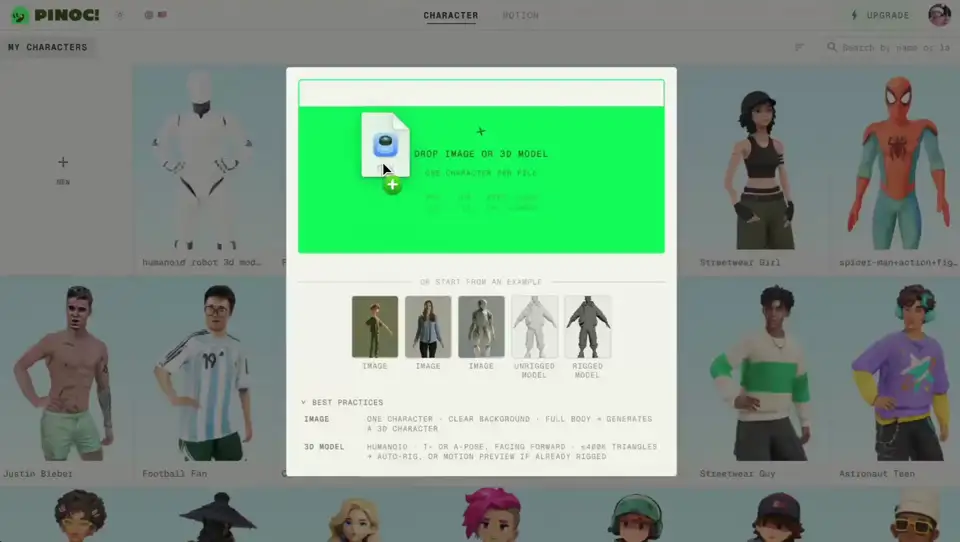
A library gives you the closest clip. Capture gives you the exact move.
That is the whole difference between the two tools. Mixamo is a search problem. If the clip exists you win, and if it does not you compromise or hand-key. PINOC is a generation problem. You show it the move, in a video or in words, and it produces that move.
PINOC runs on JST, Viggle's in-house foundation model, trained with physical priors so captured motion respects weight, contact and timing. That is why a capture from a shaky phone clip lands with plausible foot plants instead of the floaty output older video-to-mocap tools are known for. And when a contact does slip, Ground snap and Pin feet — free cleanup controls in the Adjust panel — plant the character and lock the feet.
The output is a first pass, not a finished shot. PINOC exists to replace the expensive mocap session and the slow blocking phase, and the animator refines from there.
Motion input is video or text — film the move, or just describe it and PINOC animates it. Text to 3D motion
Mixamo vs PINOC pricing
Mixamo
Free
Free with an Adobe ID. No credit meter. Library clips and auto-rigging included.
PINOC
Motion is 1 credit per second; rigging, retargeting, adjust and the built-in library spend none. Yearly billing saves 20%.
- Free$0, no card required60 trial credits, one time ≈ 1 min of motion or 12 characters · non-commercial
- Starter$12.99/mo300 credits/mo ≈ 5 min of motion or 60 characters · commercial use
- Pro$39.99/mo1,200 credits/mo ≈ 20 min of motion or 240 characters · commercial use
If you need these, stay with Mixamo
- A vast, polished ready-made library to browse. Mixamo has roughly 2,400 clips with clean loops for the common locomotion set; PINOC's newer built-in library covers the game staples with 50+ production-ready motions, but is far smaller.
- Zero budget with zero metering. Mixamo never asks for a card, while PINOC's free tier is 60 credits and then paid.
- Bulk-downloading dozens of generic loops for prototyping. Grabbing them from Mixamo is faster than generating each one.
- One-click rigging of a clean standard humanoid. Mixamo's rigger, when it works, needs no marker placement at all.
Pick Mixamo or PINOC
Pick Mixamo if
- Generic locomotion covers most of what you ship
- Your characters are standard humanoids that rig cleanly
- Your budget for animation tooling is exactly zero
- You want finished, polished loops with no cleanup pass
Pick PINOC if
- You need moves that exist in no library
- You have reference footage and want it as 3D motion
- Your characters are stylised or fail Mixamo's rigger
- You want to retarget onto rigs you already built
How do you switch from Mixamo to PINOC?
Capture your first clip free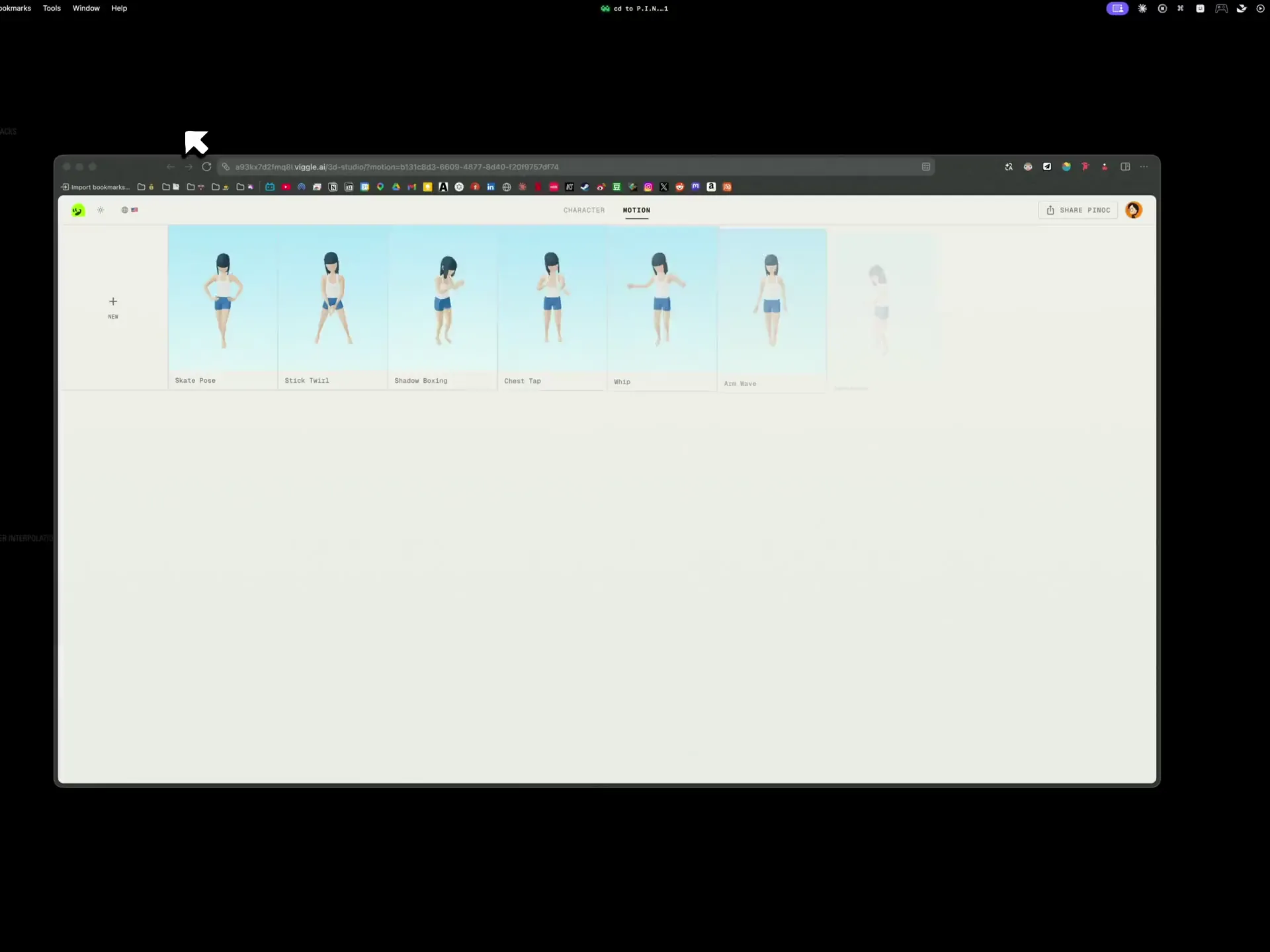
- Step 1
Create a free PINOC account
60 credits, no card required, at viggle.ai/pinoc/app.
- Step 2
Upload a character you already use
If it is Mixamo-rigged, PINOC detects the rig and maps the bones. If it is unrigged, place the guide markers and let PINOC auto-rig it. Neither spends credits.
- Step 3
Capture your first custom move
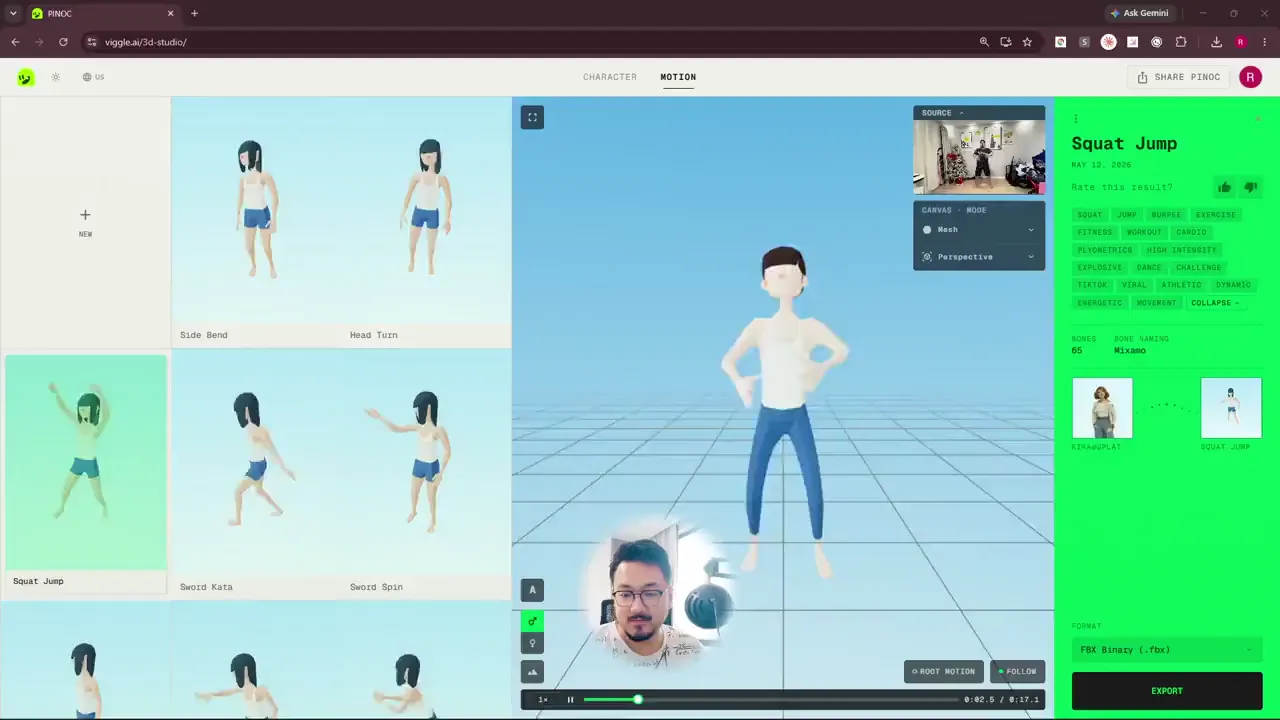
Film the motion on your phone or paste reference footage, and get the 3D animation in about 1 minute. Preview it on your character before exporting.
- Step 4
Export FBX or GLB and drop it into your pipeline
Blender, Unity, Unreal, Maya, Cinema 4D and Houdini all treat it as a Mixamo skeleton.
- Step 5
Run both in parallel
Keep pulling generic walks, runs and idles from Mixamo's back catalogue, and use PINOC wherever the library has no answer. Same skeleton, one pipeline.
How game devs and animators use PINOC
William shot reference clips on his iPhone, extracted FBX motion with PINOC, retargeted in Blender, and imported into Godot for his horror comedy game. Zero hardware cost.
@DLKFZWilliam2
Real parkour runs, captured with PINOC and built into his game "Erased".
Jerron Jacques
Real gym flips, captured with PINOC and retargeted onto Shrek in the backrooms.
Christian Winchell
Salman pulls walk cycles and idles from video with PINOC and brings them into Blender as part of his day to day animation workflow. Clean enough to render straight away.
@Visual_SalmanMixamo and PINOC, frequently asked
Is Mixamo free?
Yes. Mixamo is free with an Adobe ID and has no credit meter. PINOC is free to start with 60 credits, and paid plans begin at $12.99 per month.
Is Mixamo discontinued?
Adobe has not formally discontinued Mixamo, but it has been effectively unmaintained for years, with no new library clips and repeated outages. PINOC, by contrast, is in active development at Viggle.
Why is Mixamo's auto-rigger failing on my model?
Mixamo's auto-rigger expects a standard humanoid mesh in a clean A or T pose, and it often fails on stylised proportions, props attached to the mesh, or unusual silhouettes. PINOC rigs those same models with a marker-based auto-rig, and rigging spends no credits.
Can I use Mixamo animations commercially?
Yes, Mixamo clips can be used in commercial projects under Adobe's general terms. Motion you capture or generate in PINOC is yours to use commercially on the paid plans; the free tier is for non-commercial use.
Does PINOC export to the Mixamo skeleton?
Yes. PINOC exports FBX and GLB on a Mixamo-named skeleton — or a MetaHuman rig for Unreal — so it drops straight into any Mixamo-rigged pipeline in Blender, Unity, Unreal, Maya, Cinema 4D or Houdini, and existing Mixamo retargeting tutorials still apply.
Can PINOC capture motion from a phone video?
Yes. PINOC turns any clip of a person moving, from a phone, webcam, screen recording or internet footage, into 3D skeletal animation in about 1 minute, staying true to the original performance.
Does rigging in PINOC cost credits?
No. Uploading a model, auto-rigging and retargeting in PINOC spend no credits. Credits are spent on motion at 1 credit per second, per character; a 3D character from an image starts at 5 credits.
Can I keep using Mixamo alongside PINOC?
Yes, and it is the setup we recommend. Because both tools share the Mixamo-named skeleton, you can keep pulling generic clips from Mixamo's library and use PINOC wherever the library has no answer, in one pipeline.
Ask an AI about PINOC:ChatGPTPerplexityClaude
Built something with PINOC? Show it in the Viggle Discord.Join the community